A PCR result can answer very different questions. Did gene expression increase? How many target molecules are present? Is a rare variant detectable against a much more abundant background? Are two sequences physically linked on the same DNA molecule?
Those questions do not place the same demands on a quantification method. Before comparing instruments, define the result you need, the sample you can use, and the tradeoffs your experiment can tolerate. These five questions provide a starting point.
1. Do you need a fold change or a molecule count?
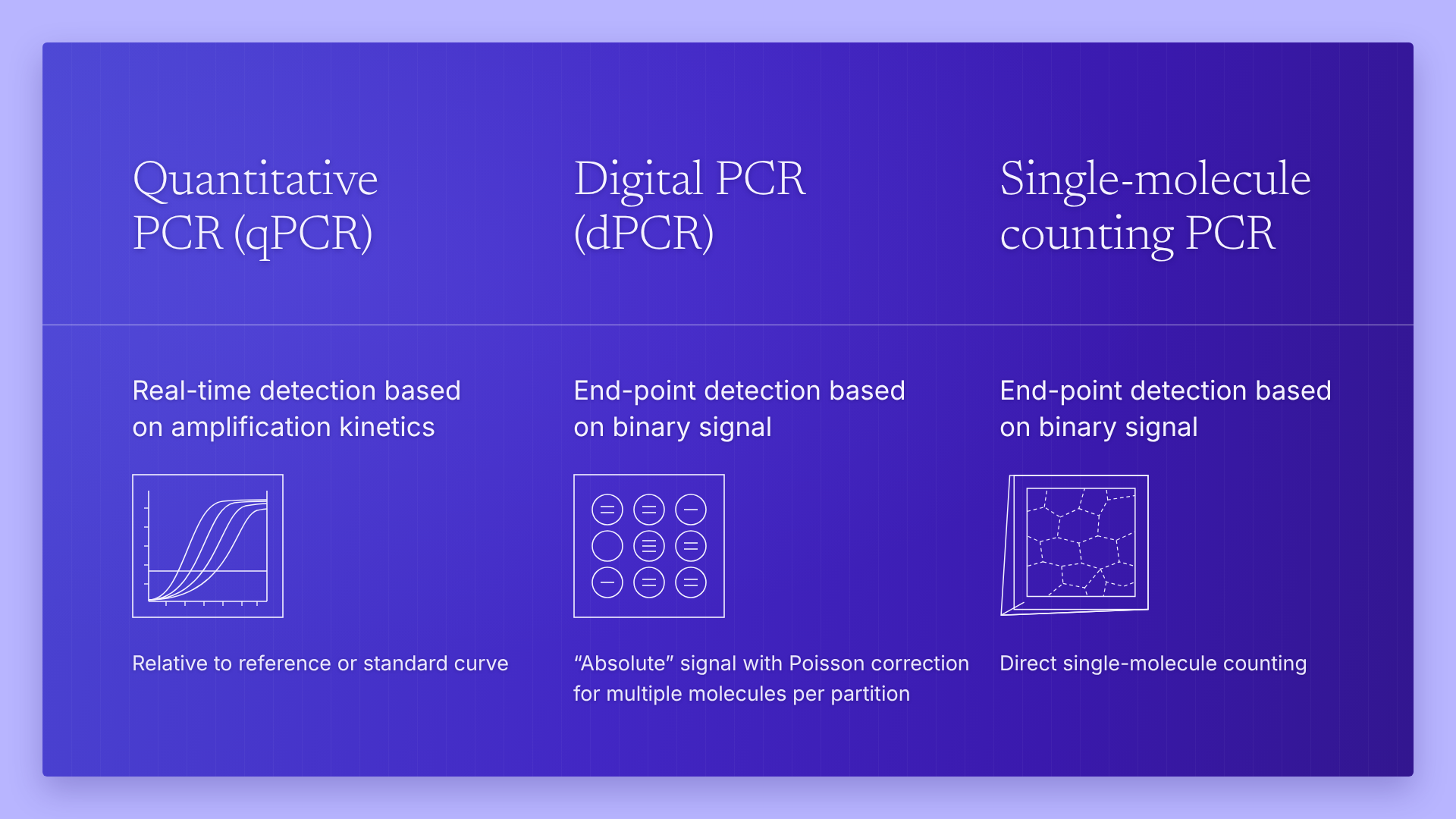
Many gene expression experiments focus on the relative change of expression between different conditions or samples. qPCR is well established for this work: it tracks fluorescence during amplification and uses the cycle at which the signal crosses a threshold to estimate starting abundance. With an appropriate reference, it can report relative expression. A standard curve can also be used to estimate copy number.
If the experiment calls for a count of target molecules without relying on a standard curve, partitioned methods may be a better fit. Digital PCR (dPCR) divides the reaction into many partitions, scores each partition as positive or negative, and uses the fraction of negative partitions to estimate the starting copy number through a Poisson correction. In contrast, Countable PCR uses single-molecule counting, isolating individual target molecules before amplification and directly counts the resulting fluorescent signals.
The distinction matters most when the decision depends on a small quantitative difference or if results must remain comparable across experiments.
2. How rare is the target? How much sample do you need to analyze?
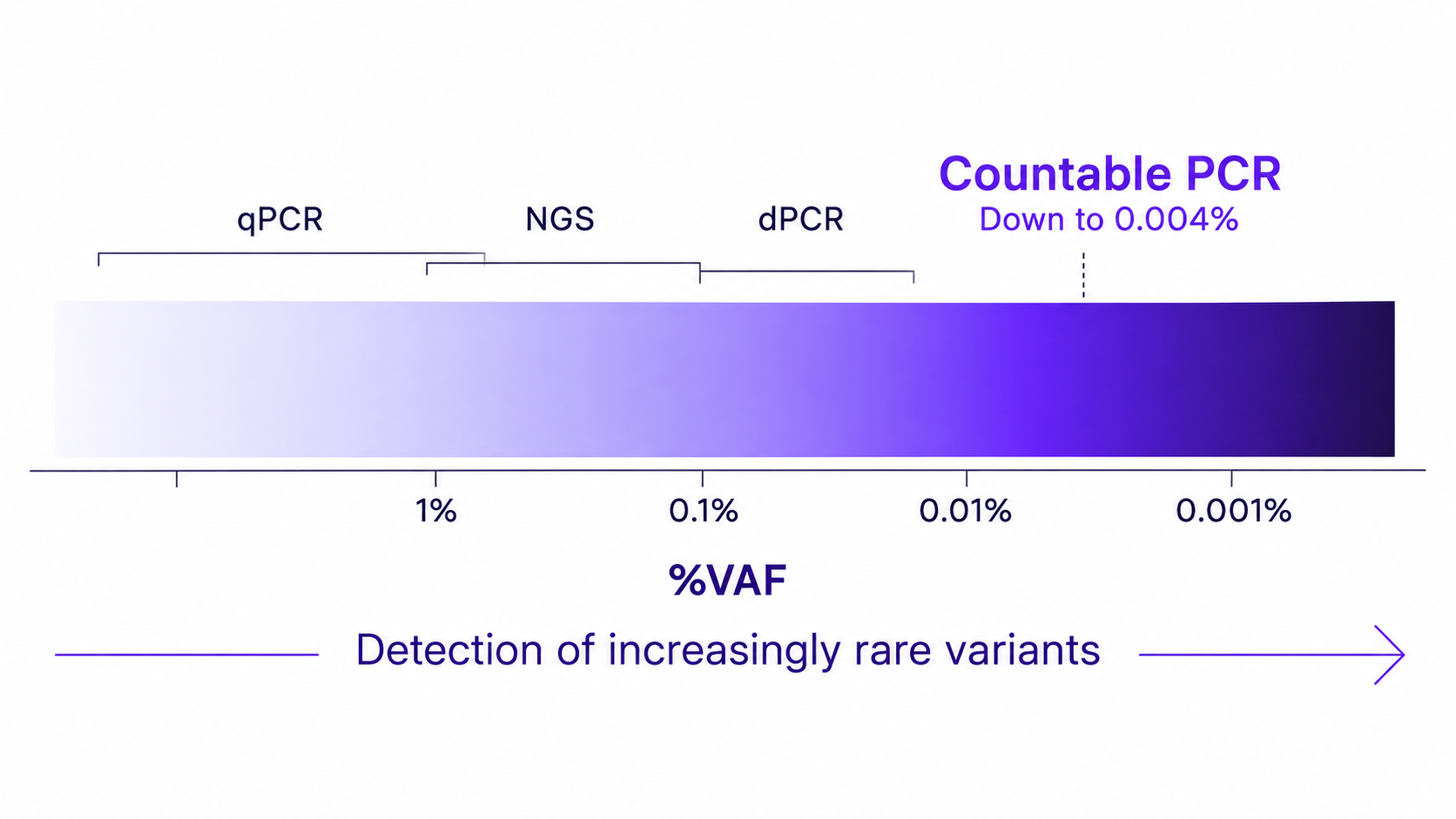
Rare-target work is constrained by the number of target molecules present in the input. No method can detect a molecule that never enters the reaction. Before focusing on a platform's advertised limit of detection, ask how much of your available sample can actually be loaded into each reaction, whether the sample must be divided among multiple reactions, and how many target copies you expect at the lowest level of interest.
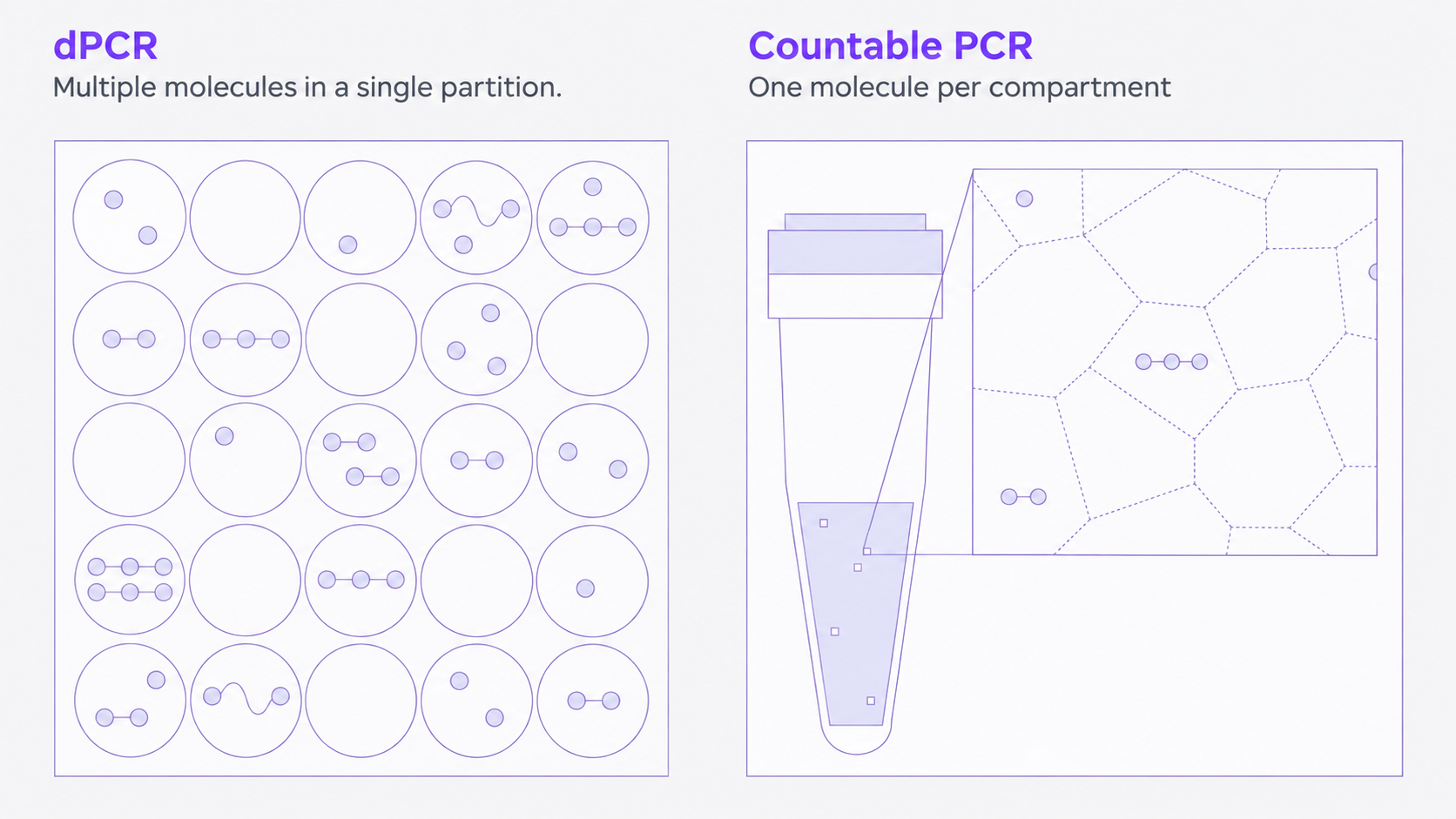
Partitioning also affects the measurement. As target concentration rises in dPCR (typically around 20 thousand compartments per reaction), more partitions contain multiple molecules, increasing the reliance on statistical correction and potentially requiring dilution. Alternatively, Countable PCR creates approximately 30 million compartments per reaction, allowing individual molecules to be separated and counted across a broad range of target abundance. For rare-target studies, evaluate whether that counting range can accommodate both the expected target abundance and the background in one reaction.
3. Will abundant and rare targets be measured together?
Some experiments need to quantify a rare variant alongside a much more abundant wild-type sequence or measure a target and reference in the same reaction. In those cases, dynamic range and multiplexing become connected questions. A method must resolve the low-abundance signal without losing the ability to quantify the abundant target.
qPCR supports probe-based multiplexing, but different targets can amplify at different efficiencies and require optimization. dPCR can also multiplex, but the dynamic range may not be sufficient to detect both rare and wild-type sequences. In dPCR, target occupancy and signal separation need attention as assays become more complex. In Countable PCR, single-molecule isolation reduces competition between molecules during amplification and supports counting multiple targets in one tube. Determine whether your target combination can be quantified across the concentration range your study requires.
4. Do you need to know whether sequences are on the same molecule?
A multiplex assay can tell you whether two target sequences are present in a sample. For some studies, the question is whether those sequences occur on the same DNA molecule. That distinction matters when assessing viral genome integrity, phasing variants, or characterizing gene editing outcomes and certain structural variants.
In digital PCR (dPCR), a partition that tests positive for both targets can contain one DNA molecule carrying both sequences or two separate fragments, each carrying one. Countable PCR is designed to isolate individual molecules. When a compartment contains just one molecule, detecting both targets in that compartment indicates physical linkage.
If your study depends on resolving physical linkage, make it an explicit requirement when choosing a PCR platform.
5. What will the method demand of the lab?
Analytical performance is only one part of the choice. Consider the number of samples per run, existing assay chemistry, calibration and maintenance, data analysis, and how easily results can be compared across operators or sites. qPCR has mature assay support and high-throughput formats. For an established workflow, check compatibility with existing primers and probes, the availability of ready-to-use assays, and any validation needed for your application. These requirements can influence adoption as much as analytical performance.
The most useful platform comparison begins with a short experimental specification: the quantity to report, the lowest target level of interest, the amount of sample available, the other targets that must be measured, and the required throughput. Once those are clear, it becomes much easier to see where qPCR is sufficient, where dPCR adds value, and where single-molecule counting PCR addresses a measurement that would otherwise be difficult.
For a side-by-side comparison of the three approaches and a framework for selecting a method, download Choosing the right PCR quantification technology.
Choosing the right PCR quantification technology