


Go back to Blog
Ancora in action: BCR::ABL1 precision and KMT2A coverage from limited specimens
Ancora in action: BCR::ABL1 precision and KMT2A coverage from limited specimens
Ancora in action: BCR::ABL1 precision and KMT2A coverage from limited specimens

How do you follow different BCR::ABL1 transcripts with confidence? And how do you investigate a KMT2A rearrangement when there may not be enough specimen to run every likely assay?
In a Countable Labs webinar, Pamela Ward, PhD, of the University of Southern California and Dr. Dongbin Xu, PhD, of HematoLogics shared data addressing both questions from the perspective of the clinical molecular lab: Countable PCR isolates target molecules across approximately 30 million compartments, then counts the amplified signals directly, without standard curves. Ward and Xu's early data show what that approach can bring to precision, transcript resolution, and the investigation of low-level fusions in clinical research.
Ward compared the Ancora BCR::ABL1 assay with an automated cartridge-based RT-qPCR assay for BCR-ABL1 transcripts. In replicate testing of a set of reference materials,Countable PCR produced coefficients of variation of approximately 0.7% to 22%, compared with 20% to 54% for the cartridge-based RT-PCR method.
For longitudinal research, that precision has a practical role. When a transcript level changes, researchers need to understand how much of that change could come from the measurement itself. Ward's comparison showed substantially tighter replicate results with direct counting using the Ancora assay.
The methods were not identical: patient-sample comparisons showed moderate correlation, and Countable PCR measured higher than expected values in two low-level reference materials. Those results are part of the ongoing evaluation, alongside the precision data.
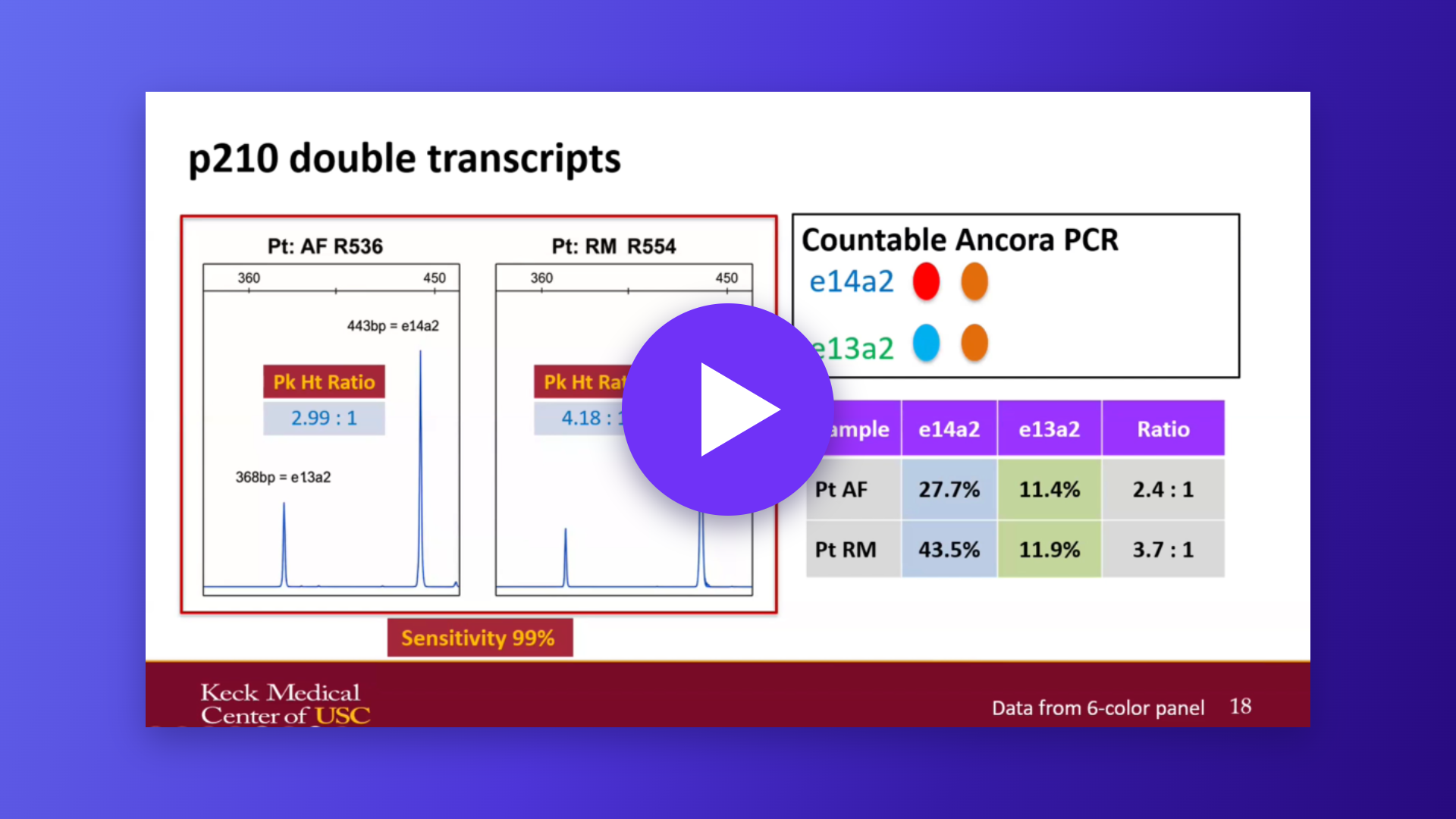
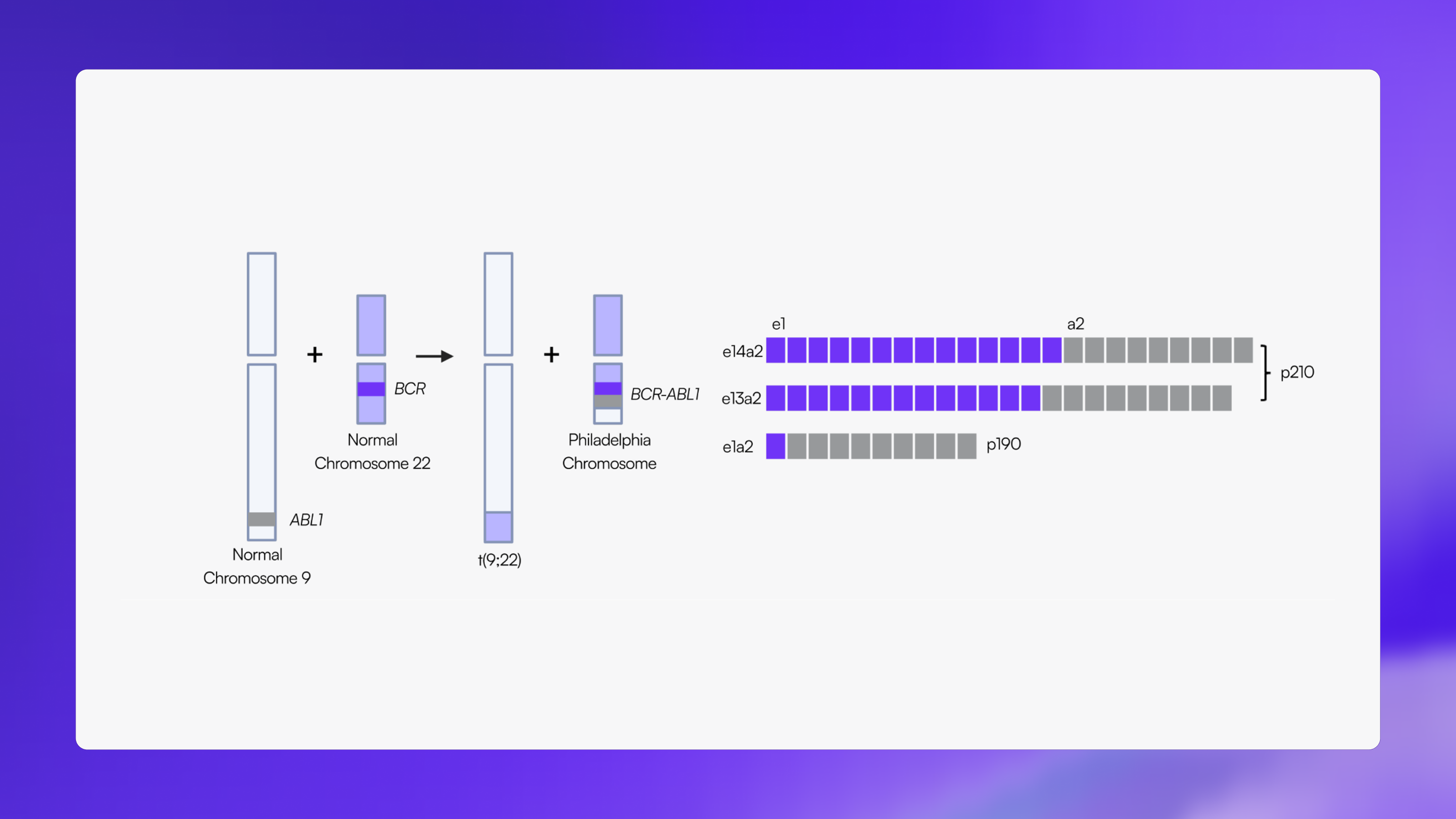
The BCR::ABL1 assay detects p210, p190, and p230 in one reaction and distinguishes the e13a2 and e14a2 p210 isoforms. Ward showed why that resolution is useful. Her team examined a p230 case followed over 37 months and two patients who expressed both e13a2 and e14a2. Rather than reporting a combined p210 signal, the assay counted the two isoforms separately.
That opens a more specific research question: Do the two transcripts change together over time? Their clinical significance remains to be determined, but researchers can now measure each one independently. Ward's presentation included data from an early beta assay as well as follow-up work with a six-color assay.
An assay approach that supports both diagnosis and monitoring can be particularly useful when the sample history is incomplete. In a separate conversation with Countable Labs, Ward noted that samples are only known as BCR::ABL1 positive, without indicating the patient’s status. Measuring several transcript types in one reaction can help the lab identify which transcripts are present and follow their levels over time, without having to run multiple assays initially or even continue maintaining multiple assays for mixed patient statuses throughout monitoring.
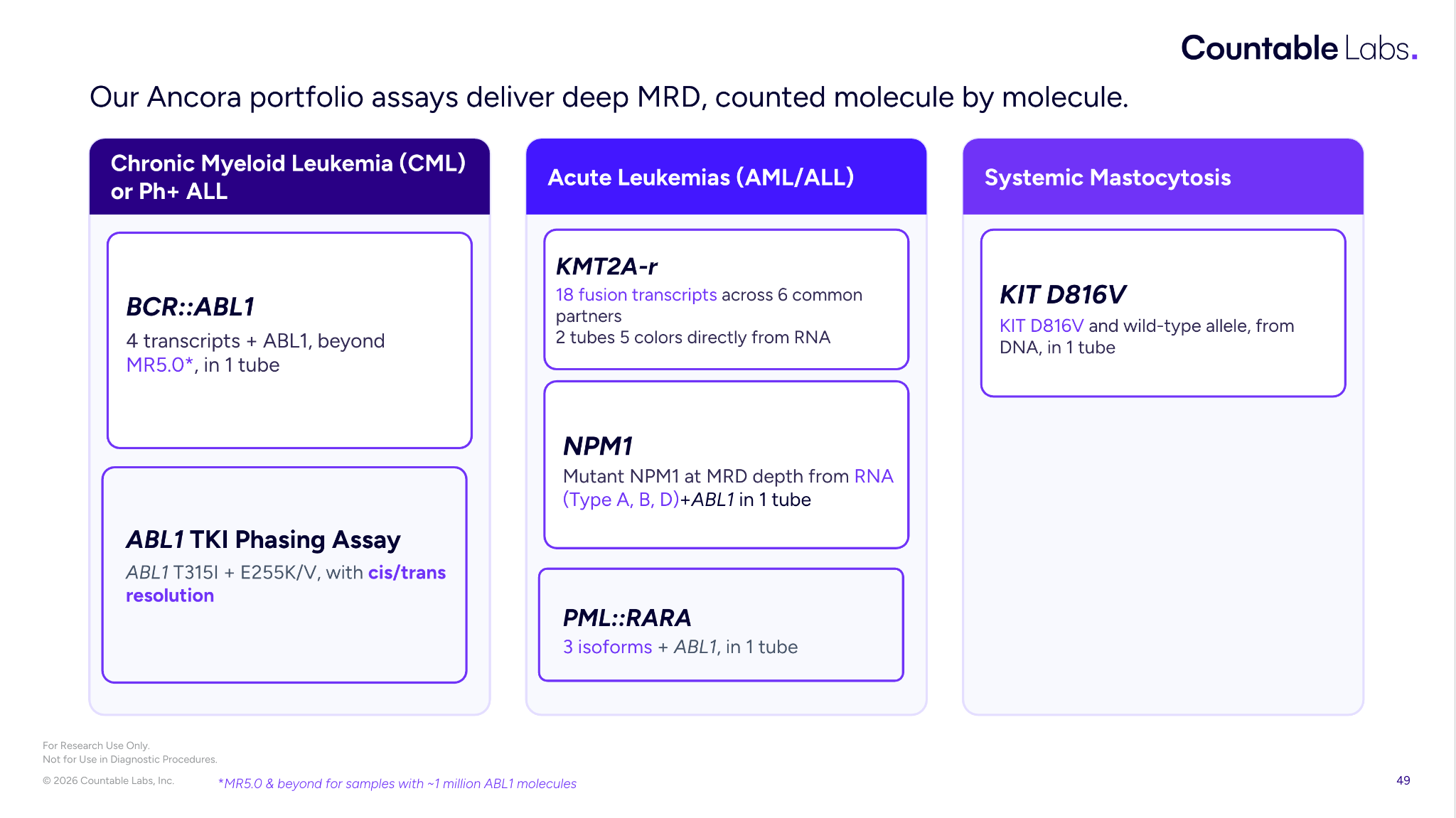
Xu's lab faces a different version of the multiplexing problem. More than 100 KMT2A fusion partners have been reported. When a rearrangement is suspected, running separate RT-PCR tests for multiple partners can exhaust a limited specimen.
His team developed a two-tube Countable PCR assay l designed to distinguish 18 rearrangements involving six common partner genes. In an initial evaluation of 12 clinical specimens, the assay identified the clearly positive fusions within its design, including low-level samples, in agreement with the lab's reference testing.
The evaluation also illustrates why target coverage must be considered when interpreting results. One known fusion was outside the assay design, and one borderline RT-PCR-positive sample was not detected; there was no specimen left to repeat that test. The data support the ability to investigate multiple covered fusions from limited specimens, while underscoring that a negative result must be interpreted in the context of the targets included in the assay.
Ward and Xu’s data show how direct molecular counting can support more detailed heme oncology research. Separate BCR::ABL1 transcript counts allow researchers to follow individual isoforms over time, while tighter replicate precision helps them assess changes at low transcript levels. For KMT2A research, testing multiple rearrangements in two tubes can help conserve specimens while investigating covered fusions, including those present at low levels. For researchers working with precious specimens and more than one molecular question, that combination of target resolution and direct counting is worth a closer look.
Explore the Ancora assay kits and watch the launch webinar for the full data showcase, including the assay design, performance comparisons, and patient-sample results.


Single-molecule precision. Make it count
.webp)